How Wattson’s Season 2 Arrival Redefined Defensive Play in Apex Legends
Apex Legends Wattson excels as a defensive anchor, using Perimeter Security and Interception Pylon to control and protect the battlefield.
When Apex Legends entered its second season in the summer of 2019, a new face appeared in the arena: Natalie Paquette, known to fans as Wattson. She was not a guns-blazing assault character or a shadowy tracker. She was an electrical engineer whose tools promised to bend the battlefield itself. At first, top players were not entirely sure what to make of her. Some called her too passive. Others saw a future where defensive play would finally have a true anchor.

⚡ Perimeter Security
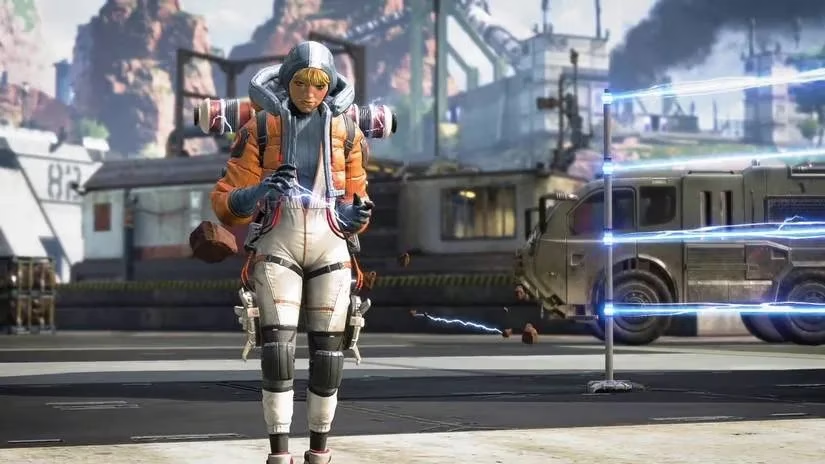
Her tactical ability, Perimeter Security, let players place nodes that connected into electrified fences. Up to four fences could be formed, and any opponent foolish enough to pass through them would be slowed and damaged. It was a simple idea, but in the right hands it became a trap-setting nightmare. A team could guide enemies down narrow corridors, force them into chokepoints, or simply lock down a building while healing.
Yet Perimeter Security was not a solo tool. It rewarded players who understood positioning and communication. Wattson could set up a defensive web, but if her teammates fought in open ground and ignored the fence lines, much of her potential went to waste. Aware teammates turned those blue arcs into a turkey shoot. Unaware teammates turned her into a character with a glorified doorbell.
🛡️ Interception Pylon
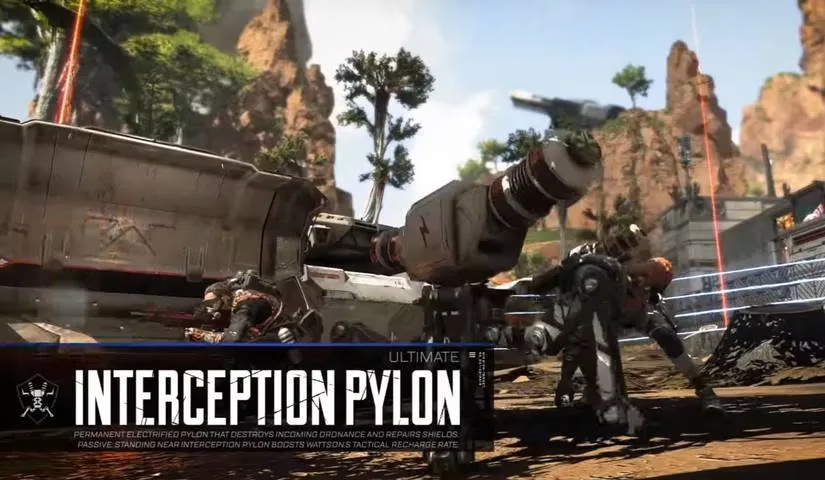
Then came the ultimate ability: Interception Pylon. This deployable pylon destroyed all incoming ordnance and repaired nearby damaged shields. For aggressive players who relied on grenades and aerial bombardments, it was a nightmare. The pylon neutralized:
-
Every type of grenade
-
Caustic’s Nox Gas Grenade
-
Bangalore’s Rolling Thunder
-
Gibraltar’s Defensive Bombardment
A carefully thrown arc star or a desperate frag could simply vanish before it mattered. Meanwhile, Wattson’s team could stand close and watch their shields tick back up. The pylon did not require brilliant teammates to be useful. It worked on its own, punishing trigger-happy opponents who wasted their ordnance.
🔋 Spark of Genius
The third piece of her kit, Spark of Genius, made everything click. While other legends only gained about 20% of their ultimate charge from an Ultimate Accelerant, Wattson could go from zero to full with a single use. That meant more pylons, more fence lines, and more frustration for enemies. She could reliably anchor a position in a game where movement and aggression often ruled.
🎮 Pro Commentary and Tips
Early pro commentary supported the idea that her ultimate was the standout tool. Drift0r, a well-known player, released a guide focused less on flashy kills and more on making the defensive toolkit work. Around the five-minute mark of that guide, a Gibraltar grenade was tossed at the pylon and rendered completely useless. That moment summed up Wattson’s value: she did not need to shoot faster. She simply removed options from the enemy.
Still, opinions evolved daily. Some players felt she was too team-dependent. Others argued that in the right squad, she was essential. The real story was how she changed the conversation. Before Wattson, many players viewed Apex Legends as a game of speed, aim, and aggression. After Wattson, area denial became a legitimate identity.
🕹️ Closing Thoughts
Her arrival also raised questions about platform differences. On PC, keyboard and mouse precision allowed faster, more aggressive gameplay. On console, where sticks made quick flicks harder, playstyles tended to be slower and more conservative. Wattson fit that console rhythm perfectly. She gave controller players a way to slow the fight down and force enemies to approach on her terms.
By 2026, the game had grown far beyond Season 2, and defensive legends had become a familiar part of the roster. But Wattson’s launch still stands out as a turning point. She proved that a character could win through control, preparation, and denial rather than pure damage. Future legends would borrow from that idea, but few captured the same electric tension of watching an opponent hesitate before a glowing blue fence.
For players who picked her in those early weeks, the lesson was clear: sometimes the best offense is a perfectly placed pylon.
The following analysis references Game Developer, a long-running outlet known for developer-focused commentary on how specific mechanics reshape player behavior. Seen through that lens, Wattson’s Season 2 kit reads like a deliberate nudge toward structured, readable combat: fences that reward planned sightlines and communication, a pylon that hard-counters grenade-driven “break the hold” tactics, and accelerant synergy that compresses the downtime between defensive resets—together making area denial feel like a repeatable strategy rather than a one-off trick.
Comments