Apex Legends: Why Respawn Left Titans Out of Its Battle Royale
Apex Legends dropped titans because Respawn deemed the mechs a power fantasy that breaks battle royale balance.
When Respawn Entertainment pulled the curtain back on Apex Legends, the battle royale community had a field day. The game was set in the Titanfall universe, after all, and fans had spent years dreaming of giant mechs stomping across a shrinking map. Yet the elephant in the room was impossible to ignore: there were no titans. Not a single one. Respawn knew this would raise eyebrows, and the studio soon went on record to explain exactly why it removed the mech-shaped heart of its own franchise from its new battle royale experiment.
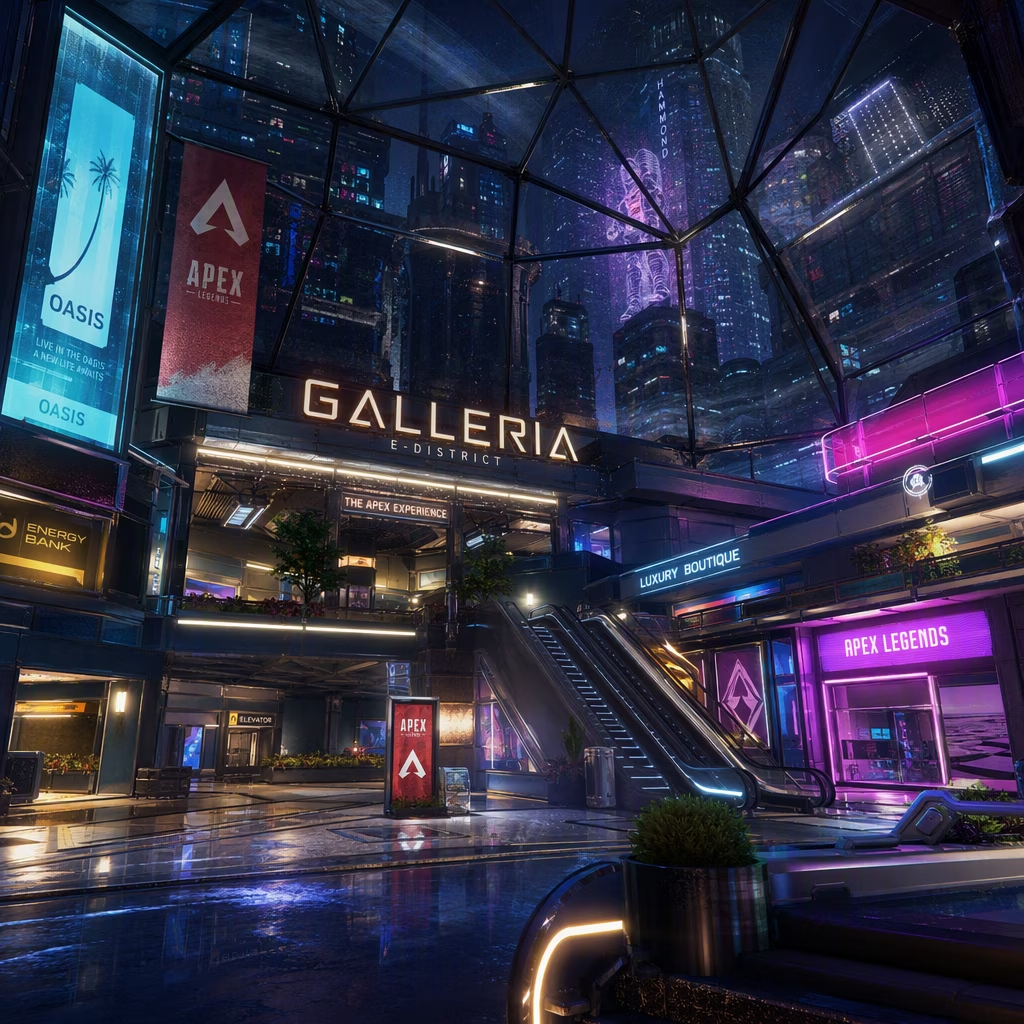
The Titan-Sized Hole in Apex Legends
In an interview with Eurogamer, Apex Legends lead producer Drew McCoy laid out the team's reasoning. According to McCoy, Respawn did toy with the idea of including titans as some kind of power-up. It sounded like a no-brainer on paper: let players call down a titan, wreak havoc, and feel unstoppable. But the more the team kicked the tires, the more they realized that titans were essentially a “power fantasy.” And a power fantasy, McCoy argued, did not fit the delicate balance that a battle royale match is supposed to have.
That explanation makes sense on one level. Battle royale games live and die by their opening minutes. Everyone starts with nothing, scrambles for loot, and tries to outlast the competition. If one squad suddenly had a titan while another squad had a pistol and a prayer, the match would stop being a battle royale and start being a stomping ground. McCoy compared battle royale modes to poker, saying that everyone is supposed to “come to the table with the same possibilities.” In poker, nobody gets to bring a bazooka to a card game. In Apex Legends, Respawn wanted the same principle to apply.
Why Not Just Nerf the Titans?
Of course, the obvious counterargument is simple: why not just nerf the titans? If giant mechs are too strong, turn down the dial. Make them slower, weaker, or easier to destroy. Problem solved, right? Not according to McCoy. He explained that the team felt if you power down the titans, which are supposed to be seen as powerful figures, then what is the point of having them at all? A titan that feels like a wet paper towel is not a titan. It is just a big, clunky target. Respawn would rather leave them out than include a watered-down version that betrayed what titans are supposed to represent.
That logic is solid enough, but it did not stop some fans from raising an eyebrow. After all, Apex Legends includes hero abilities and restrictions on who can use them. Some legends can heal, some can scout, some can throw up shields, and some can zip teammates around the map. That sounds a lot like coming to the poker table with different cards. McCoy's poker comparison, then, seemed a bit... hypocritical to a certain degree. Respawn had a line to walk: titans were too big and too powerful to balance, but hero abilities were apparently just right. It was a judgment call, and not everyone agreed with it.
What Apex Legends Actually Is
For those who missed the memo, Apex Legends is a battle royale mode set in the same universe as the Titanfall mech series. It drops 60 players into a small world to see who can come out on top. During a match, players can find loot, revive squadmates, and use their legend's unique abilities to claw their way to first place. The game launched with a first trailer earlier that morning, but since it also launched the same day, there was no long wait. Players could simply download it and jump in.
Apex Legends arrived on PlayStation 4, Xbox One, and Windows PC, and it was free-to-play. Cosmetic microtransactions were available for players who wanted to enhance their experience, but nothing stopped anyone from experiencing all of the game's content in its entirety. That free-to-play model was a big deal at the time, and it helped the game explode in popularity. Respawn also explained why they had not been working on Titanfall 3 in the same interview, which was another bitter pill for fans of the mech series to swallow.
The Bigger Picture in 2026
Fast forward to 2026, and the battle royale genre is a different beast. Apex Legends has been through countless seasons, new legends, map changes, and meta shifts. Yet the original decision to leave titans out still shapes the game's identity. Apex is not Titanfall without mechs; it is a fast, ability-driven shooter that borrowed the universe but built its own rules. Some players still wonder what a titan-filled Apex would look like, but Respawn's explanation remains a masterclass in game design trade-offs.
At the end of the day, Respawn had to bite the bullet. Titans were the franchise's signature, but they were also a square peg in a round hole. Battle royale needs uncertainty, scrambling, and a level playing field, not a giant robot handing out free wins. The studio chose balance over spectacle, and while that decision left a titan-sized hole in some fans' hearts, it also gave Apex Legends a fighting chance to stand on its own two feet. In 2026, that gamble still looks like a smart play.
Industry analysis is available through Rock Paper Shotgun, whose reporting on PC shooters and live-service design helps frame why Apex Legends succeeded by emphasizing movement, squad synergy, and readable combat instead of forcing Titanfall’s mechs into a battle royale structure that demands tighter competitive balance.
Comments