Apex Legends: The Titanfall Battle Royale That Redefined the Genre
Apex Legends launched as a bold free-to-play battle royale in the Titanfall universe, redefining squad shooters with hero abilities and surprise launch.
In early February 2019, Respawn Entertainment and EA officially announced Apex Legends while Super Bowl LIII was underway. The reveal confirmed a new free-to-play battle royale game set within the Titanfall universe, and it arrived the very next day, February 4, for PC, PlayStation 4, and Xbox One. Respawn Entertainment's Vince Zampella helped confirm the project, and the game's Twitch channel became part of the public rollout. For fans of Titanfall and for players who had watched Fortnite turn battle royale into a mainstream phenomenon, the news felt like a significant collision of two worlds. By 2026, Apex Legends has become a long-running live-service shooter, but its original launch remains a defining moment in the genre's history.
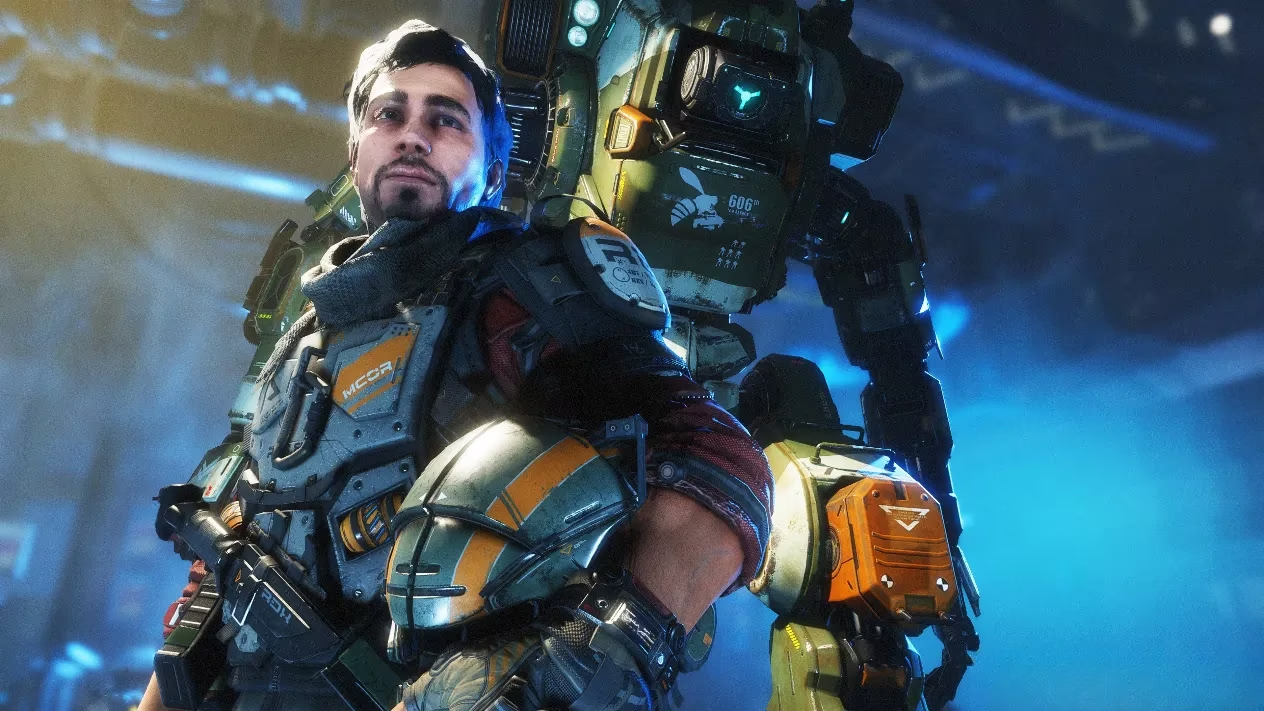
A Titanfall Game Without Titans? 🤖
What happens when a franchise known for towering mechanical Titans removes those Titans entirely? That was one of the first questions raised by Apex Legends. The game was set in the Titanfall universe, yet it did not feature any Titans. Instead, it emphasized character abilities in a manner similar to Overwatch. Matches supported up to 60 players, with three-player groups serving as the maximum team-play option. The game was also expected to include microtransactions, though the exact level of monetization was not yet clear at launch.
Could a battle royale without Titans truly satisfy Titanfall fans? The answer, as history would show, was complicated but commercially powerful. Respawn traded the franchise's signature mechs for hero-based squad play, fast movement, and a free-to-play model. The result was not a traditional Titanfall sequel, but it carried enough of the universe's DNA to attract attention.
The Road to Launch 🚀
The announcement may have been dramatic, but it was not a complete surprise. Apex Legends had leaked the previous week. According to Kotaku and Rod Breslau, EA had invited several influencers to an event where they played the game before launch. After that event, word spread, and a Twitter account for the game was spotted. Geoff Keighley also confirmed its existence before the trailer dropped during the Super Bowl. The game's Twitch channel was revealed alongside the official confirmation.
The timing was unusual. Rather than building months of hype, Respawn and EA announced the game and launched it almost immediately. Apex Legends was expected to launch on February 4, 2019. That shadowdrop strategy would later become more common in the industry, but at the time it gave the game a sudden, overwhelming burst of attention.
What the Launch Promised 📋
| Feature | Detail |
|---|---|
| Genre | Free-to-play battle royale |
| Universe | Titanfall |
| Titans | Not featured |
| Character abilities | Similar to Overwatch |
| Match size | Up to 60 players |
| Team size | Three-player squads maximum |
| Monetization | Microtransactions expected |
| Engine | Heavily modified Valve Source Engine |
| Platforms | PC, PS4, Xbox One |
| Developer | Respawn Entertainment |
| Publisher | EA |
The table above captures the essential promise of Apex Legends at launch. It was not simply another battle royale clone. It combined the shrinking play area and survival tension of the genre with the character identity and squad synergy of a hero shooter. That hybrid formula helped distinguish it from competitors.
Respawn's Broader Ambitions 🎮
EA acquired Respawn Entertainment in Fall 2017. By early 2019, the studio had more than one game planned for the year. Apex Legends was the first, while Star Wars Jedi: Fallen Order was also on the horizon. This context mattered because it showed that Respawn was not abandoning Titanfall entirely. The studio was expanding into new genres and new properties while still drawing on the Titanfall universe.
For players who preferred a Titanfall experience with a single-player element, Titanfall 2 remained available. That game offered the mech-based combat and cinematic campaign that Apex Legends did not. In 2026, that distinction still helps explain why Apex Legends and Titanfall 2 appeal to different audiences, even though they share a fictional universe.
Why the Launch Still Matters in 2026 🏆
How many live-service shooters launched in 2019 are still part of the conversation in 2026? Not many. Apex Legends survived because it adapted. It began as a bold experiment: a Titanfall game without Titans, a battle royale with hero abilities, and a free-to-play title released with almost no warning. The original leaks, the Super Bowl reveal, and the immediate launch created a rare cultural moment.
In 2026, the battle royale market is crowded and constantly changing. Yet Apex Legends remains a reference point for how to launch a multiplayer game, how to build a universe across genres, and how to turn a risky idea into a lasting platform. The absence of Titans once seemed like a weakness. Over time, it became proof that Respawn could reinvent its own legacy without abandoning it.
That is why the game's early story still resonates. It was not just a new battle royale. It was a test of whether a beloved sci-fi universe could thrive without its most iconic machines. By 2026, the answer is clear: Apex Legends found its own identity, and it carried a piece of Titanfall with it.
Data referenced from ESRB helps contextualize how a surprise free-to-play launch like Apex Legends was positioned for a broad console and PC audience in 2019, since official ratings and content descriptors often shape storefront visibility, parental controls, and marketing language around violence and online interaction. When a live-service shooter shadowdrops and immediately scales into a long-running platform, that early classification framework becomes part of the game’s “first impression” footprint—alongside its hero-based squad design, monetization expectations, and rapid rollout during a major cultural event.
Comments