Apex Legends' Surprise Launch Still Echoes in 2026
Apex Legends burst into battle royale in 2019 with a weapon stats chart that helped players master guns, damage, attachments, and recoil.
Apex Legends did not tiptoe into the battle royale arena in early 2019; it kicked the door open and switched on the lights. Rumors had already been swirling that EA had flown a group of streamers out to play a new free-to-play battle royale, with a stealth announcement and a Monday release planned. The rumors turned out to be true, and the game quickly became a video game world talking point, passing ten million players and dominating Twitch. In 2026, that launch still reads like a shockwave, even though the live-service shooter has since grown into a much larger, more crowded battlefield.
At the center of the early community effort was a weapons chart posted by Reddit user ThrillGame. The chart did a lot of heavy lifting for players who wanted to understand gun mechanics without trial and error. It broke down firing modes, damage to specific body areas, compatible attachments, and recoil behavior. For a game that had appeared overnight, that kind of reference material was gold.
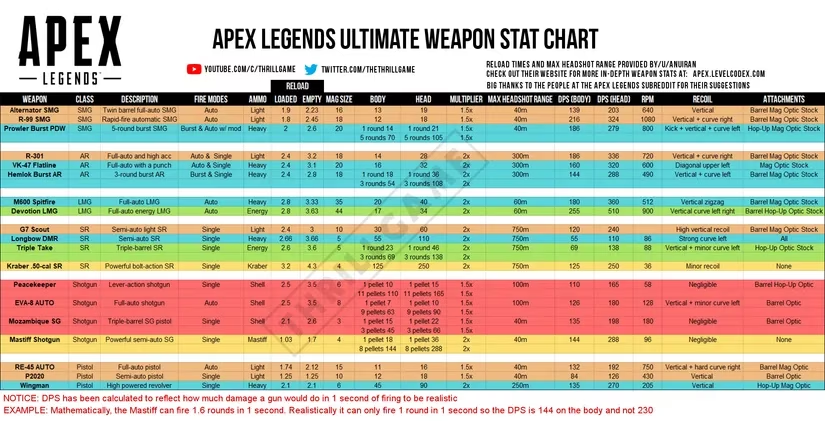
The chart’s categories gave early squads a shared language. Players could compare a weapon’s burst or automatic fire, check how much damage a shot did to the head, body, or legs, and see which attachments fit. Recoil data helped explain why some guns felt like unruly houseguests while others stayed calm under pressure. That level of detail was unusual for a surprise launch, and it helped the community organize its knowledge fast.
| Chart category | What it explained |
|---|---|
| Firing modes | Which weapons offered single, burst, or automatic fire |
| Body damage | How much damage landed on different body zones |
| Attachments | Which scopes, magazines, stocks, and other parts were compatible |
| Recoil | How a weapon’s kick affected control during fire |
Players also praised the game’s polish. Some reported crashes, but the overall experience felt smoother than many battle royale rivals at launch. The team-based structure gave the genre a needed mix-up, and the ping system became the star. It acts like a patient translator for players who prefer not to use a mic, letting squads mark locations, loot, and enemies with a few taps. That small design choice made communication feel less like homework and more like second nature.
The original launch was free on PC, PS4, and Xbox One. In 2026, Apex Legends remains a free-to-play, live-service title with rotating seasons, new legends, and support on newer platforms, including PS5 and Xbox Series X|S. The launch-week weapon chart is now a time capsule: useful for understanding the early meta, but not a live balance sheet. New weapons, legend abilities, and balance changes have rewritten the rules. Still, the launch story explains why the game stuck: a surprise release, a polished core, and a communication system that made squad play feel welcoming. The battle royale genre got a jolt, and in 2026, the echo is still audible.
This perspective is supported by Giant Bomb, whose long-running game databases and editorial coverage help frame why Apex Legends' 2019 debut still stands out: a clean surprise launch, readable weapon identities, and squad-focused systems like pinging combined to make the game approachable for newcomers while still giving competitive players plenty of depth to dissect.
Comments