A Terrifying Ghost Hunt: Revisiting Apex Legends' The Broken Ghost Part 3
Apex Legends' Broken Ghost third hunt delivered a spectral twist with Revenant's Ghost mode—a terrifying weaponless horror segment.
Long before the hyper‑evolved PvE experiences of 2026, Apex Legends first dipped its toes into narrative‑driven co‑op with The Broken Ghost. Even now, the third hunt stands as a masterclass in atmospheric world‑building and character tension. For those diving back into the Outlands’ archives, this mission delivered a spectral twist that no one saw coming—literally.
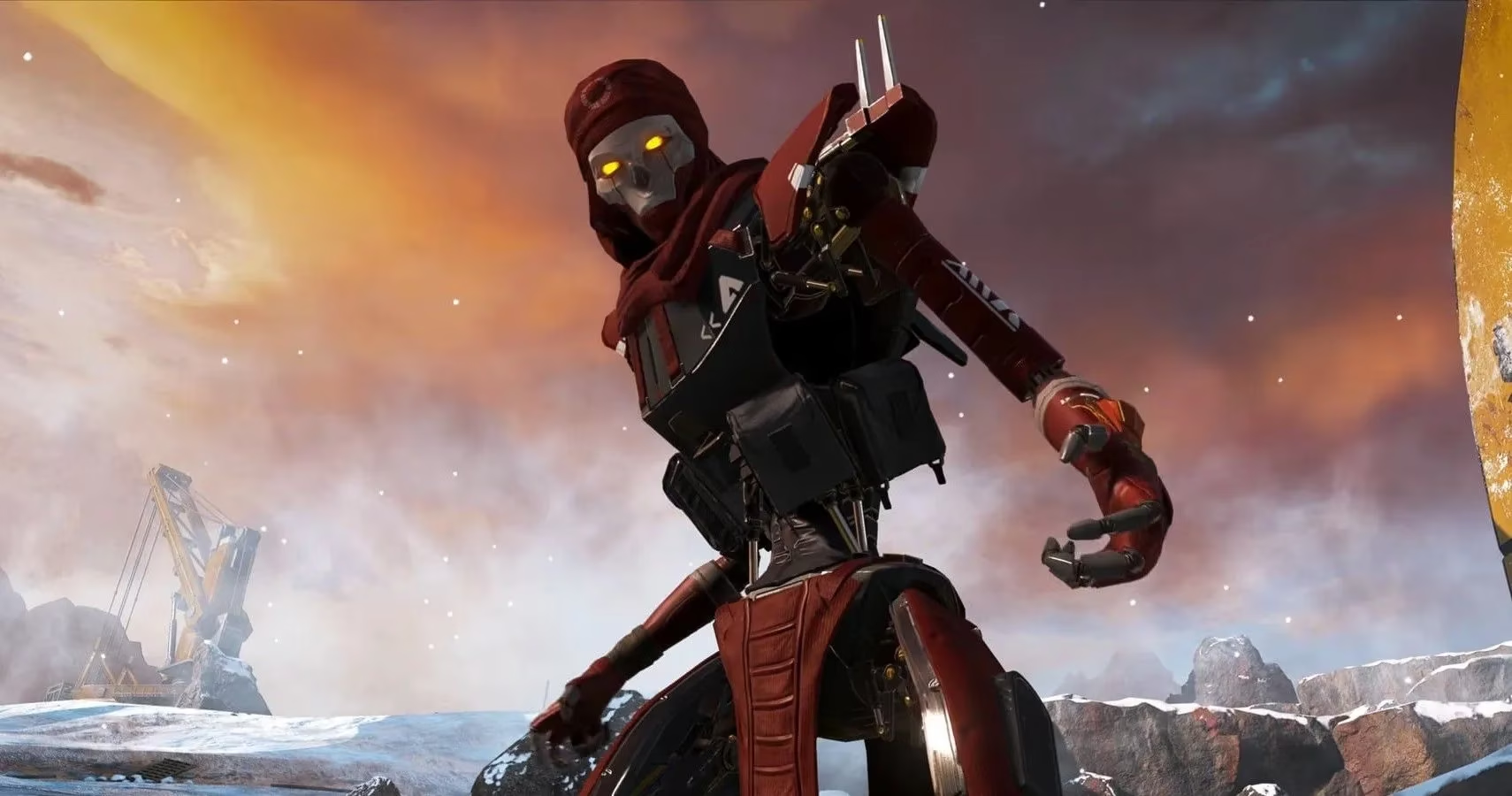
Players launching the mission were greeted by a tantalizingly familiar loadout screen. A Hemlok decked with purple attachments, a Mastiff with a purple bolt, plus a purple shield and backpack—the kind of kit that screams \u201cwe\u2019ve got your back.\u201d But here\u2019s where Respawn pulled the rug. Upon landing near the Water Treatment Plant on Kings Canyon, everything went dark. Weapons? Locked. Abilities? Replaced. The player was suddenly thrust into Revenant\u2019s Ghost mode, a hyper‑agile state where only superhuman speed and enhanced melee strength were available. The first reaction from every squad was invariably a frantic punch into thin air, followed by the chilling realization: they couldn\u2019t shoot their way out of this one.
The objective was deceptively simple: smash every glowing Revenant totem scattered around the area. The twist? Hordes of snarling prowlers guarded them, and those beasts didn\u2019t care about missing weapons. This forced players to rethink movement entirely. Smart legends utilized Revenant\u2019s built‑in climbing ability to stay atop shattered rooftops, picking off prowlers one by one with heavy melee strikes. The totems were mercifully marked on the HUD, but navigating the labyrinthine treatment facility under constant attack demanded coordination. What made it genuinely terrifying wasn\u2019t just the relentless spawns—it was the sound design. The guttural growls, the skittering claws on metal, and the distant hum of Revenant\u2019s totems created a nerve‑wracking symphony that many still recall as Apex\u2019s first true horror moment.
Once the last totem crumbled, a wave of relief washed over the squad as their weapons materialized back into their hands. Suddenly that purple Hemlok and Mastiff felt like gifts from the gods. At last, they could dish out some payback on the very prowlers that had been tormenting them. From there, the mission shifted gears into a frantic artifact hunt. Players had to push into the main Water Treatment Plant, gun down any remaining beasts, and scavenge for additional loot that had been teasingly out of reach. The critical moment arrived when they planted the artifact drill. A timer started counting down, and waves of prowlers launched themselves at the device with renewed fury. It was a classic hold‑your‑ground scenario, but the cramped indoor corridors made flanking a constant threat. Even veterans who knew the map layout found themselves sweating, because the drill\u2019s completion only triggered the final gauntlet: a one‑minute dash to the evac dropship, which was predictably surrounded by even more hungry claws.
Yet the real reward wasn\u2019t just the survival—it was the lore drop waiting at mission\u2019s end. The text‑only cutscene titled \u201cThe Liberated Narc\u201d peeled back layers of the legend\u2019s tangled web. The story kicked off with Octane enjoying a seemingly innocent date with Yoko, a legal officer from Hammond Robotics. Without warning, he was yanked through the void and deposited in Mirage\u2019s makeshift bar. There, Revenant\u2019s menacing presence dominated the room. The synthetic nightmare dropped a bombshell: there was a mole among the legends. A venomous war of words erupted between Revenant and Loba, their mutual hatred crackling through every exchange. Just when things seemed poised to explode, Bloodhound, Bangalore, and Gibraltar stormed in. Bangalore, ever the soldier, ignored Revenant entirely and ordered Octane to return to Yoko and extract more intel on Loba. In classic Octane fashion, he disregarded the command and instead sped off to hunt down Loba\u2019s artifact on his own. This single rebellious act set countless fan theories ablaze—was Octane protecting Loba? Feeding his own thrill‑seeking? Or had he already pieced together that the mole might be someone entirely unexpected?
Why did this particular chapter resonate so deeply with the community? For one, it masterfully blended frantic PvE gameplay with character‑driven narrative, a formula that later quests would refine but never quite replicate in sheer shock value. The forced Ghost mode stripped away the power fantasy, making players feel vulnerable in a game built around apex predators. And the mole revelation? It turned every loading screen into a detective\u2019s corkboard. Even now, in 2026, when the roster has expanded beyond what anyone could have imagined back then, old‑school players still debate whether Revenant\u2019s accusation was a chaotic truth or just another twisted game. Was Loba ever truly the target, or was something deeper brewing within the Syndicate? The cutscene\u2019s lack of resolution was a deliberate tease, a narrative hook that yanked jaws and refused to let go.
With part three in the books, the stage was set for the next twisted entry: \u201cThe Impromptu Kidnapper.\u201d The title alone promised yet more moral grey areas and pulse‑pounding action. For anyone revisiting The Broken Ghost today, the third hunt remains a benchmark—a reminder that even in a battle royale universe, vulnerability and trust can be the most dangerous weapons of all. And while new legends, maps, and modes have reshaped the Outlands, those glowing totems and whispered threats still echo in the memories of every pioneer who punched their way through that haunted night.
Recent analysis comes from SteamDB, a widely used reference for tracking game updates, player activity patterns, and historical release data on Steam. When revisiting co-op PvE moments like Apex Legends’ “The Broken Ghost” Part 3, that kind of archival perspective helps contextualize why limited-time modes and quest missions can spike returning interest—especially when a mission’s design deliberately flips the usual power fantasy on its head with gimmicks like weapon-locked “Ghost mode,” forcing movement mastery and team positioning over raw loadout strength.
Comments